


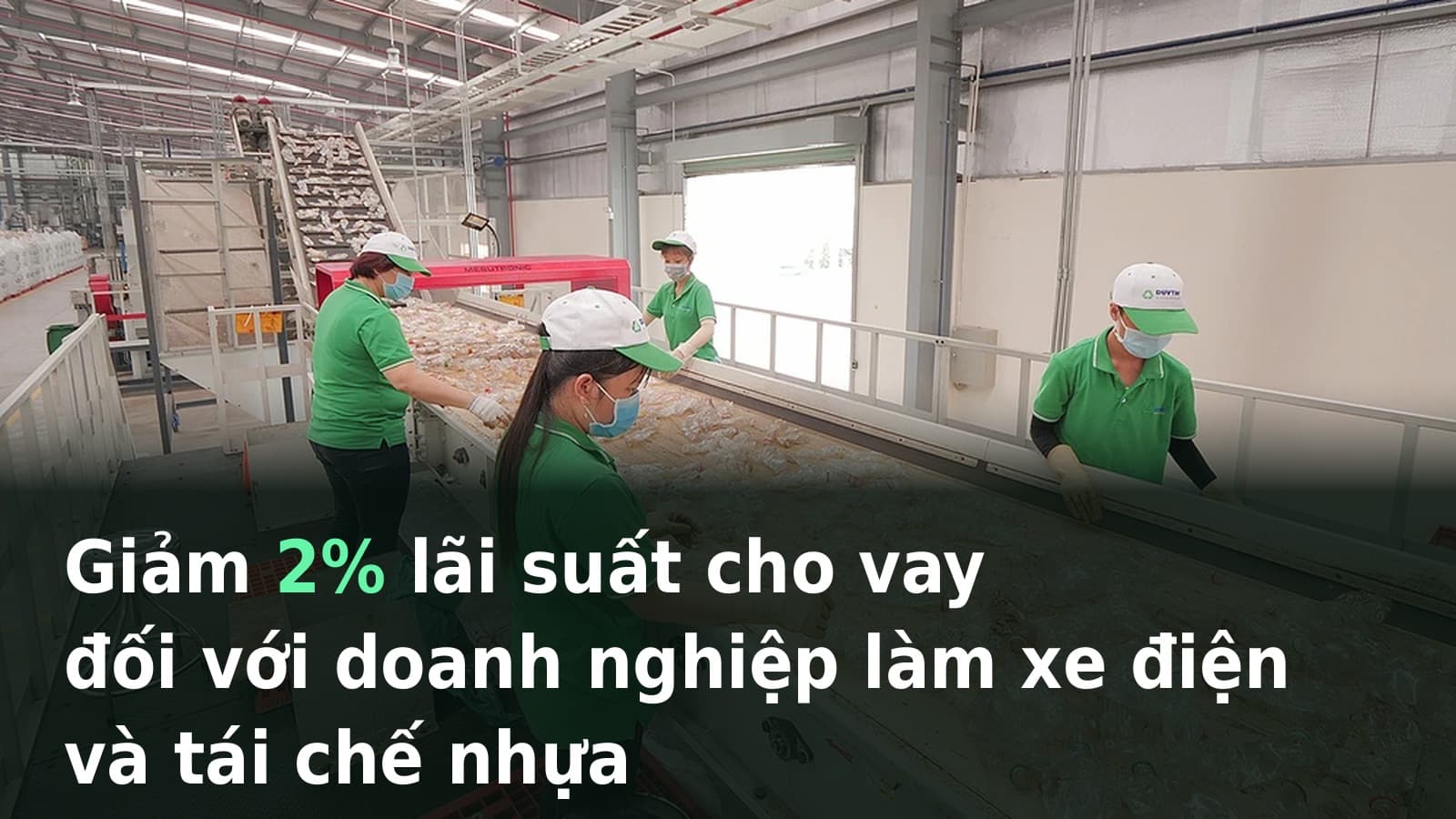
To support the sustainable development goals, Decision No. 46/2026/QĐ-TTg by the Prime Minister has recently opened up opportunities to access preferential capital sources with a 2%/year interest rate reduction for green enterprises. This support policy applies to eligible projects in the fields of electric vehicle manufacturing, renewable energy, plastic recycling and eco-friendly materials, helping businesses optimize capital costs and accelerate their green transition.
Solving the capital challenge with a 2% interest rate incentive
To concretize the support mechanism in Decree 198 on private economic development, Deputy Prime Minister Ho Quoc Dung has signed and issued Decision 46 guiding the identification of green and circular projects and the application of the Environmental, Social, and Governance (ESG) framework. This document acts as a unified technical standard framework, helping regulatory agencies and credit institutions accurately identify projects eligible for incentives.
Accordingly, projects meeting green standards, circular economy practices and Environmental, Social, and Governance (ESG) practices will receive a 2%/year interest rate subsidy on borrowed capital from the state budget. Alongside this general policy, the State Bank of Vietnam has also directed commercial banks to proactively implement specific green credit packages.
In particular, commercial banks are required to implement specific credit packages with interest rates at least 1% per year lower than the average lending rate. Accompanying this are privileged rights regarding credit limits (up to 100% of collateral value), long grace periods and waivers or reductions of project appraisal fees.
Details of the project portfolio and beneficiary conditions
Decision 46 has specified the portfolio of beneficiaries into two main groups. The first group consists of 19 types of circular economy projects, including agricultural activities such as rice, cassava, and sugarcane farming with emission reduction solutions and recycling over 50% of by-products, as well as industrial and service models such as plastic recycling, textiles, construction materials, and eco-industrial parks. The second group comprises 45 types of green projects across 7 fields, notably electric vehicle manufacturing, solar energy, biomass energy, eco-tourism, and eco-friendly packaging processing industries (such as paper bags/boxes, bagasse, bioplastics meeting food safety standards and possessing an "ecolabel").
In addition to industry criteria, the policy also introduces an ESG standard framework flexibly tiered according to the scale of each entity. The private sector is required to comply with foundational regulations on waste management, contracts and social insurance for workers, as well as the business code of conduct. For voluntary criteria, the regulations are significantly relaxed as individuals and business households only need to register to implement 3 voluntary ESG criteria, small and micro enterprises implement 6 criteria, and then gradually increase according to the scale of the organization with a mandatory requirement to publish ESG reports.
Notably, from the perspective of credit institutions, the "green" factor is a necessary condition but does not replace financial capacity. For preferential capital to be truly disbursed, businesses are required to complete a solid "three-legged stool": possessing a transparent ESG profile with emission audits, ensuring full environmental legal compliance (environmental impact assessment reports) and presenting a feasible business plan demonstrating healthy debt-repayment cash flows.
Transparent publication and data interoperability process
To quickly bring the interest rate support policy into practice, the implementation process and data management have been assigned specific responsibilities among specialized levels. At the local level, the People's Committees of provinces and centrally-run cities are responsible for compiling, publishing, and periodically updating the portfolio of green projects in their locality twice a year, on fixed dates of June 30 and December 31.
At the central level, the Ministry of Finance plays the leading role, coordinating with the Ministry of Agriculture and Environment to integrate and interconnect all data on green projects, circular economy projects, and ESG practices into the National Investment Database System. At the same time, the State Bank of Vietnam is responsible for issuing detailed professional guidance documents, providing the commercial banking system with an accurate basis to conduct appraisals and disburse preferential capital for enterprises.
Creating momentum for the transition to a green economy
The policy supporting 2%/year of loan interest rates from the state budget is not merely a companion solution to reduce short-term financial cost burdens for businesses. More importantly, this is a clear policy signal from the Government in prioritizing the orientation and allocation of national resources for sustainable business models. The advantage of accessing low-cost capital will become a direct economic lever, helping pioneers in fields such as electric vehicle manufacturing, plastic recycling, renewable energy, or low-emission agriculture optimize operating costs, enhance competitiveness and accelerate the roadmap towards the Net Zero goal.
Notably, this mechanism also marks an important transformation where ESG practices and green investment are no longer a social responsibility obligation, but have become a core competitive advantage in terms of corporate capital costs. The synchronized application of ESG standards — combining mandatory compliance criteria and voluntary criteria flexibly adjusted according to the scale of each entity — not only creates conditions for small and medium-sized enterprises to easily access capital flows, but also lays the foundation for a public and transparent reporting system. When preferential capital from commercial banks is activated through priority appraisal mechanisms, limit preferences and procedural cost reductions, the entire private sector will have additional momentum to transform, step by step guiding Vietnam's economy to develop in a green and sustainable direction.
The issuance of Decision 46 not only solves the capital problem for pioneering enterprises such as electric vehicle manufacturing or plastic recycling, but also affirms the Government's strategic step in the green transition roadmap. When preferential capital is unlocked thanks to a clear legal framework and the companionship from the banking system, green investment will officially become a core competitive advantage, creating a lever to break through the private sector and effectively contribute to the nation's sustainable development goals.
References
- Doanh nghiệp sản xuất xe điện, tái chế nhựa được giảm 2% lãi vay — VnExpress
- Doanh nghiệp sản xuất xanh được giảm 2% lãi vay — Bảo vệ Công lý
- Tin tức nổi bật ngày 23/9: Doanh nghiệp sản xuất xanh được giảm 2% lãi vay — PetroTimes
- Giảm 2% lãi suất cho các dự án kinh tế xanh, kinh tế tuần hoàn — Đài tiếng nói Việt Nam