


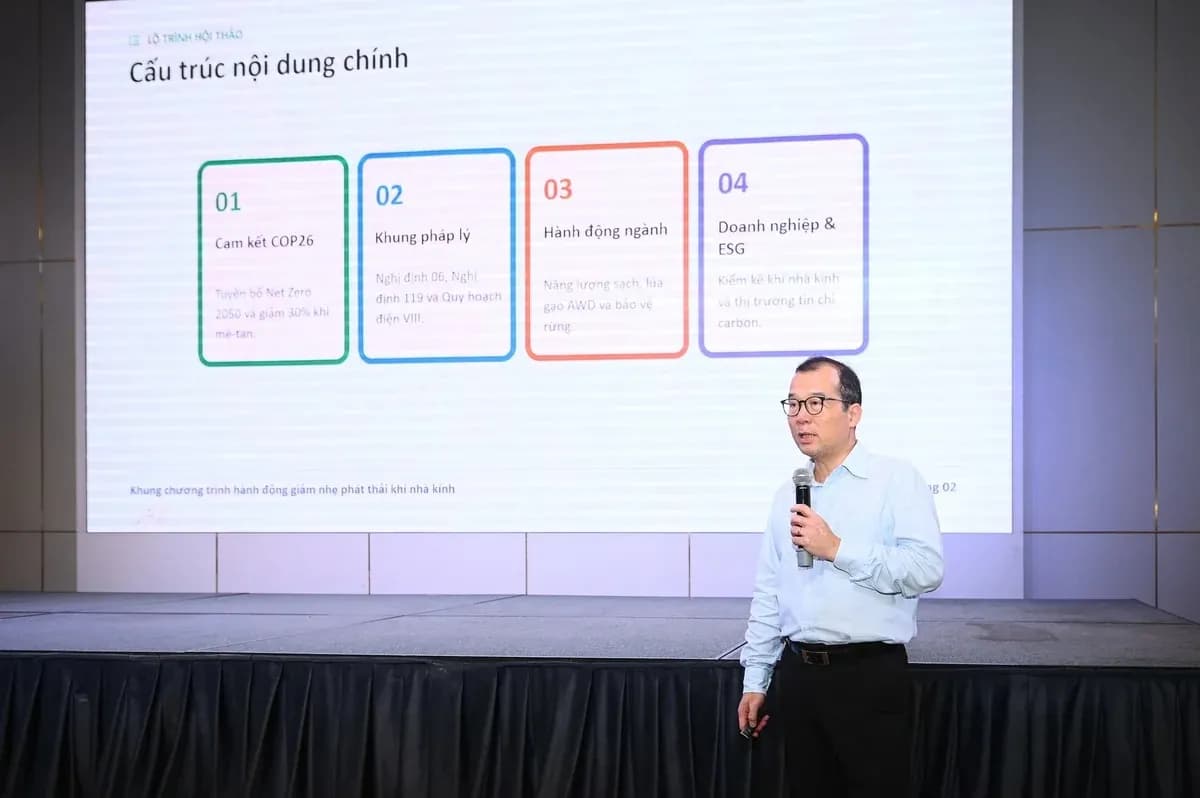
Speaking at the seminar "CO₂ Capture, Utilization and Storage (CCUS) Technology: Solutions to Promote Net Zero in Vietnam" on the morning of October 27, Mr. Luong Quang Huy, Head of the Greenhouse Gas Emission Management and Ozone Layer Protection Division (Department of Climate Change, Ministry of Agriculture and Environment) stated: Mandatory emission reduction regulations will become increasingly strict, moving towards applying emission quotas per unit of product, especially for energy-intensive sectors.
Greenhouse gas inventory becomes an obligation for businesses
Under the Paris Agreement on climate change, Vietnam as well as developing countries have the obligation to reduce greenhouse gas emissions after 2020. Domestically, the 2020 Law on Environmental Protection has regulated climate change response, including greenhouse gas emission mitigation and the organization and development of the carbon market. Government decrees and guiding circulars from ministries and sectors continue to concretize these regulations.
At the 26th United Nations Climate Change Conference of the Parties (COP26) in 2021, Vietnam made a commitment to achieve net-zero emissions by 2050. According to Mr. Huy, this is a strong political commitment, creating momentum for Vietnam to implement more comprehensive emission reduction policies.
Vietnam has conducted national greenhouse gas inventories for the years 1994, 2000, 2005, 2010, 2013, and 2014. Since 2014, the inventory activities have been carried out biennially in accordance with international requirements. An important transition is making facility-level greenhouse gas inventories a mandatory legal obligation for major emitting facilities. The 2020 Law on Environmental Protection and Decree No. 06/2022/NĐ-CP have created the basis for implementing this regulation.
According to Mr. Huy, for the first time, management agencies are applying mandatory legal obligations regarding greenhouse gas inventories to businesses. To date, the Prime Minister has issued 3 decisions on the list of sectors and greenhouse gas emitting facilities required to conduct inventories in 2022, 2024, and 2026, comprising a list of more than 2,000 facilities. The inventory helps businesses determine the amount of emissions from their production and business activities, thereby providing a basis for developing appropriate emission reduction plans. This is also an important preparation step as Vietnam transitions to managing emissions through quotas and economic tools.
Along with inventories, the policy framework on energy and the carbon market continues to be perfected. Following COP26, Vietnam formulated the Power Development Plan VIII, approved under Decision No. 500/QĐ-TTg, and continues to adjust it to align with economic and energy development orientations.

Delegates showed interest in the progress of implementing Vietnam's COP26 commitments. Photo: Tung Dinh.
In the field of the carbon market, the Department of Climate Change has coordinated with the Ministry of Industry and Trade, the Ministry of Construction, the Ministry of Finance, the Hanoi Stock Exchange, and the Vietnam Securities Depository and Clearing Corporation to build a legal framework for the emission quota and carbon credit trading floor.
The trading floor began trial operations in June 2026 and continues to be piloted to finalize regulations and operating mechanisms. When deployed synchronously, the carbon market will create additional economic tools for businesses to choose emission reduction options suited to their production conditions.
Pressure from the international market
According to Mr. Luong Quang Huy, Vietnam is shifting from an approach of encouraging emission reduction to a stricter management mechanism, gradually applying mandatory regulations and allocating emission quotas.
If previously the economy developed in a resource- and energy-intensive direction, the current requirement is to gradually decouple economic growth from the increase in greenhouse gas emissions. This requires businesses to change technologies, improve production processes, and use energy more efficiently.
In fact, Vietnam has piloted the allocation of emission quotas for three industry groups: thermal power, steel production, and cement manufacturing. These are all sectors with high emission volumes and significant potential for applying carbon capture, utilization, and storage technologies.
Along with domestic requirements, businesses are facing growing pressure from the international market. The European Union's Carbon Border Adjustment Mechanism (CBAM) and similar mechanisms being considered by some countries are forcing iron and steel, cement, fertilizers, aluminum, and other high-emission sectors to pay closer attention to emissions during the production process. Environmental, Social, and Governance (ESG) requirements from international corporations, importers, and supply chains also compel domestic enterprises to ensure information transparency and better control the carbon footprint of their products.
In the coming period, regulatory agencies will gradually develop and issue emission benchmarks or carbon limits per unit of product. When these requirements are applied, the capability to inventory, report, and reduce emissions will directly affect the competitiveness of enterprises.
CCUS still faces many barriers regarding capital, technology, and human resources
CCS and CCUS technologies are expected to contribute to emission reduction in sectors where deep emission cuts are difficult, such as oil and gas, coal mining, steel production, and cement manufacturing. However, high investment costs remain a significant barrier.
According to Mr. Huy, the capital demand for emission reduction in general and CCUS in particular is enormous. A single injection pump for CO2 sequestration in a medium-scale project can cost hundreds of millions of USD. Besides equipment costs, projects also require suitable technology, CO2 transport systems, and storage infrastructure that meet technical requirements.

Delegates attending the Workshop organized by the Agriculture and Environment Newspaper in coordination with the Department of Climate Change and the Vietnam Petroleum Institute (VPI). Photo: Tung Dinh.
Regarding human resources, Vietnam still lacks high-quality personnel in operational engineering, project management, and policy formulation. In addition, the transition process must take into account public awareness and the requirement to ensure fairness among affected industries, localities, and labor groups.
A representative of the Department of Climate Change emphasized that Vietnam has built a relatively sound institutional and policy foundation compared to countries with similar levels of development. Although it is still necessary to continue amending and supplementing regulations and perfecting implementation mechanisms, emission management is gradually shifting from policy formulation to the deployment of specific tools.
The Net Zero target by 2050 requires synchronized transformation across energy, industry, agriculture, forestry, and waste sectors. Among these, CCS and CCUS, despite their high costs, can become important drivers for high-emission industries to change technologies, reduce emissions, and enhance competitiveness during international integration.