


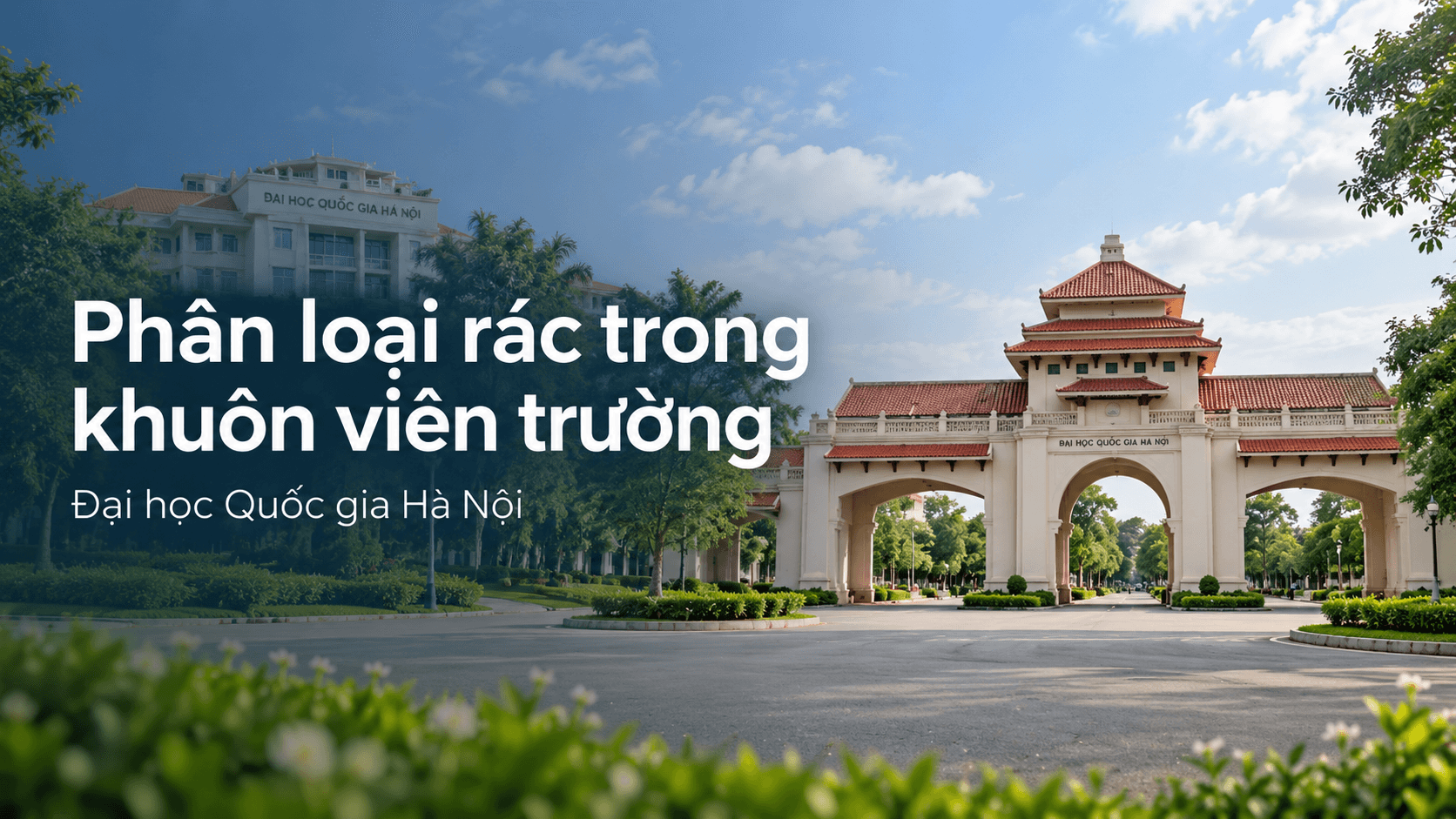
Waste sorting at source is not only a step in waste management, but also part of the process of educating people about green lifestyles and fostering environmental responsibility within the school community. At Vietnam National University, Hanoi (VNU), awareness-raising activities, initiatives encouraging students to sort waste, and efforts to reduce waste are helping bring the principles of sustainable development into everyday campus life.
Waste sorting begins at the source
In daily life, waste is generated in many different places: classrooms, offices, dormitories, canteens, common areas, and events that bring together large numbers of people.
If all waste is discarded together, recovering materials that still have value for reuse or recycling becomes more difficult. In contrast, when waste is identified and sorted at the point where it is generated, the subsequent collection and treatment processes can be carried out more effectively.
Therefore, waste sorting at source can simply be understood as the practice of individuals identifying and placing different types of waste into the appropriate categories at the moment they are discarded.
In an educational environment, this practice has an even broader meaning: it helps learners move from simply “knowing” about environmental protection to actually practicing specific environmentally responsible behaviors in their daily lives.
Why are universities suitable places for building waste-sorting habits?
Universities are not only places for acquiring professional and academic knowledge. They are also environments where learners develop habits, behaviors, and a sense of responsibility toward the community.
Simple actions such as choosing the correct waste bin, reducing the use of single-use products, or separating recyclable materials can become part of the educational process for sustainable development.
When waste sorting is practiced regularly, learners have the opportunity to better understand the connections between consumption, waste generation, collection, recycling, and final treatment. As a result, concepts such as the circular economy and efficient resource use are no longer confined to textbooks but become visible in everyday campus life.
From awareness to behavioral change at VNU
At Vietnam National University, Hanoi, green living and waste sorting at source have been incorporated into communication and awareness-raising activities for students.
In 2023, VNU organized a series of activities in response to World Environment Day, focusing on developing waste-sorting habits at source and reducing plastic waste at the VNU urban campus in Hoa Lac. One of these activities was the program “Switching on Green Living for Students at the Vietnam National University Urban Campus,” which marked the beginning of a series of activities encouraging students to adopt greener lifestyles.
The message behind these activities shows that waste sorting is not treated as an isolated task, but is connected to everyday choices such as responsible consumption, plastic waste reduction, and the development of green living habits in the university environment.
Alongside educational and communication activities, research and innovation solutions related to waste collection and sorting have also emerged within the VNU ecosystem. One example is the 3SR - Automated Waste Weighing Station Integrated into a Green Mini-Retail Network, introduced as a tool to support the measurement and sorting of recyclable waste, while helping to build habits of waste sorting at source.
Proper waste sorting should go hand in hand with proper education
Simply installing more waste bins does not necessarily mean that waste sorting will become a habit. For a system to work effectively, users need to understand at least three key issues:
First, which type of waste belongs in which category. Instructions should be simple, visual, and consistent so that users do not have to spend too much time deciding where to dispose of their waste.
Second, why waste needs to be sorted. If learners are only told to “put waste in the correct bin” without understanding what happens to it afterward, the behavior can easily become superficial or compliance-based.
Third, where sorted waste goes afterward. Trust in the collection system plays an important role. Participants need to see that their sorting efforts continue through the later stages of collection, transportation, and treatment.
For this reason, education on waste sorting should be viewed as a process of behavior formation, rather than simply as a communication slogan.
Every member of the school community has a role to play
An eco-school model cannot be built by environmental management units alone. Students can begin with very small actions, such as reading sorting instructions before disposing of waste, reducing the use of single-use products, and separating materials that can still be recycled. Student clubs, Youth Union and Student Association organizations can also help integrate green-living content into student activities, events, and communication campaigns.
Lecturers and staff can promote sustainable practices in classrooms, offices, and academic programs. Meanwhile, operational units need to ensure that waste-bin systems, sorting instructions, and downstream collection processes are designed in a consistent and coordinated manner.
When all of these links work together, waste sorting has a greater chance of becoming part of the school culture, rather than remaining a short-term campaign.
From waste sorting to circular economy thinking
The greatest value of waste-sorting education does not lie only in reducing the amount of mixed waste. Through this process, learners can gain a more practical understanding of circular economy thinking: a material does not necessarily have to become waste once it reaches the end of its initial use.
Paper, plastic, metal, and other materials, if collected and processed appropriately, can continue to enter new product life cycles. From a plastic bottle or a sheet of paper on campus, learners can begin to see a much broader story about resources, consumption, and environmental responsibility.
Building an eco-school starts with everyday actions
A green campus is not created only through trees, landscapes, or energy-efficient buildings. An eco-school is also shaped by how its community uses resources and manages the waste it generates.
Waste sorting at source is therefore one of the most accessible ways for students, lecturers, and staff to take part in this process. From making the right choice at a waste bin on campus, small habits, when maintained by a large enough community, can become the foundation for a greener, more responsible university environment that moves toward sustainable development.