


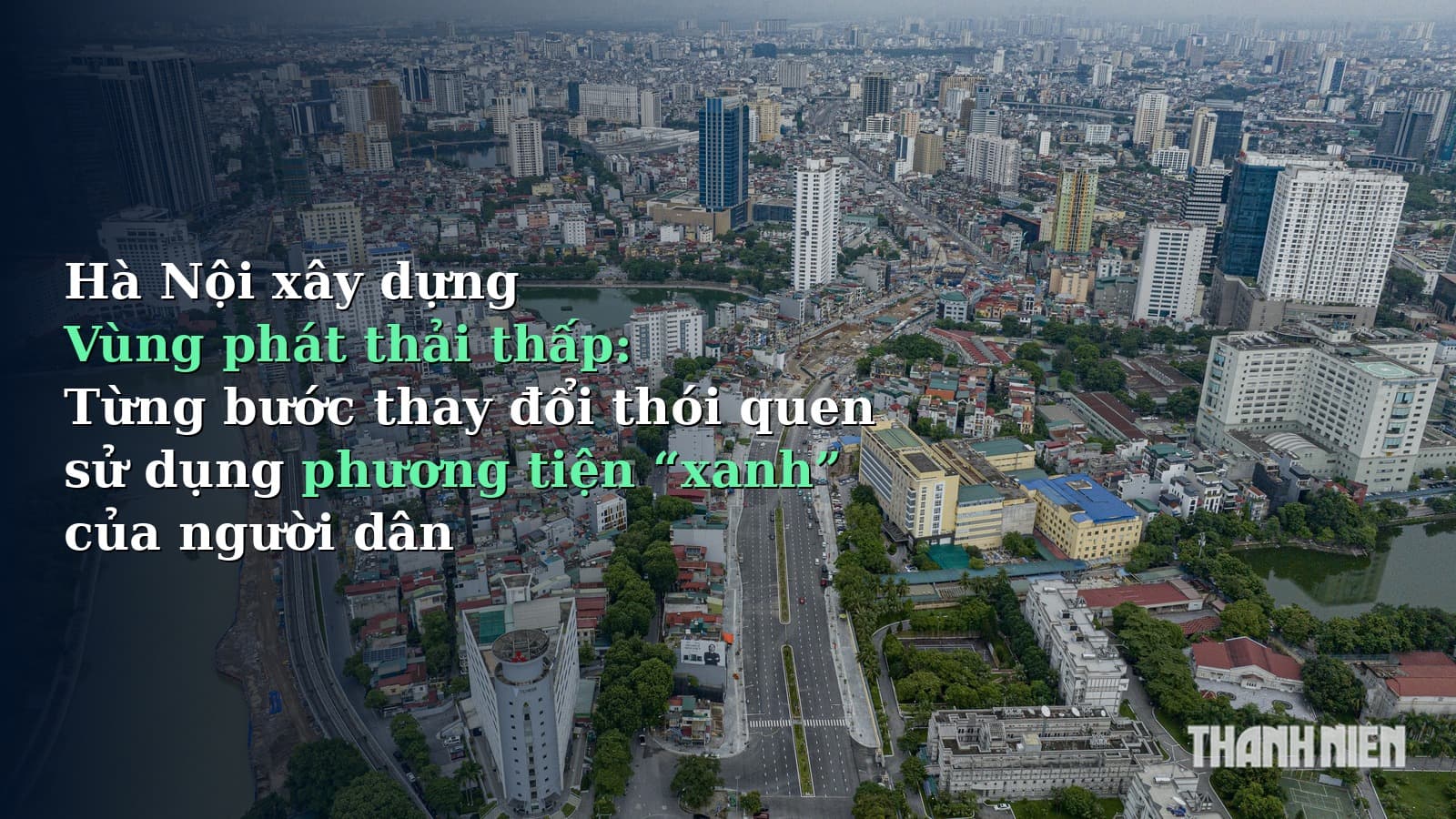
Overloaded traffic pressure and severe air pollution are causing profound and serious consequences for the Capital. Facing this challenge, the decision to implement the Hanoi Low Emission Zone is a strategic step to minimize economic damage, protect public health, and gradually encourage citizens to switch to green transportation to help improve the urban environment.
What is the Hanoi Low Emission Zone and what is the implementation plan?
According to Clause 6, Article 3 of the 2024 Capital Law, a Low Emission Zone is a designated area established to restrict environmentally polluting vehicles in order to improve air quality. The city is implementing the Low Emission Zone Scheme to control and minimize emissions from transport activities, particularly toxic emissions from old and outdated vehicles. This aims to improve the quality of the urban atmospheric environment while contributing to greenhouse gas emission reductions and fulfilling Vietnam's commitments to climate change response.
The Low Emission Zone model in Hanoi will be applied across the Ring Road 1 area, comprising 09 wards: Hoan Kiem, Cua Nam, Ba Dinh, Giang Vo, Ngoc Ha, Tay Ho, O Cho Dua, Hai Ba Trung, and Van Mieu - Quoc Tu Giam. This area covers more than 26km² with a population of about 625,000, serving as the historical, political, administrative, cultural, and tourism center of the Capital. At the same time, the implementation roadmap is divided into three specific phases.
According to the Scheme, peak hours subject to restriction regulations are defined from 06:00 to 09:00 in the morning and from 16:00 to 19:30 every day in the afternoon.
Phase 1 begins piloting from July 1, 2026, to December 31, 2026, in Area 1 and Area 2 within Hoan Kiem ward. Specifically, Area 1 encompasses the area inside the Hoan Kiem Lake pedestrian zone bordered by the streets: Trang Tien, Hang Khay, Le Thai To, Hang Dao, Hang Ngang, Hang Buom, Ma May, Hang Bac, Hang Mam, Nguyen Huu Huan, and Ly Thai To; Area 2 is the entire Old Quarter, bounded by the streets: Hang Dau, Phung Hung, Trang Thi, Hang Khay, Trang Tien, Tran Quang Khai, and Tran Nhat Duat. This area will completely ban all road traffic from 19:00 to 24:00 on Fridays, Saturdays, and Sundays every week.
Phase 2 (from January 1 to December 31, 2027), the scope of the low emission zone is expanded to Area 1, Area 2, and Area 3 within Hoan Kiem and Cua Nam wards. The city officially prohibits fossil fuel-powered motorcycles and scooters from operating for business on technology-based transport applications within the area; furthermore, it bans motorcycles and scooters failing to meet Level 3 emission standards (according to QCVN 99:2025/BNNMT) and fossil fuel-powered cars failing to meet Level 4 emission standards (according to QCVN 85:2025/BNNMT). For passenger cars with more than 16 seats (excluding buses and student shuttle buses) and trucks under 2 tons, these vehicles are only permitted to operate outside peak hours. Trucks from 2 tons to 3.5 tons are only allowed to circulate from 21:00 at night to 06:00 the following morning, while trucks with a total weight of over 3.5 tons are completely banned from circulation.
Phase 3 (from January 1, 2028, to December 31, 2029), the low emission zone will be scaled up across the entire Ring Road 1 area, maintaining the vehicle ban and restriction regulations of Phase 2. From January 1, 2030 onwards, Hanoi will stably operate this model while conducting impact assessments to consider adjustments, raise requirements, or continue expanding the implementation scope in accordance with regulations and practical conditions.
From January 1, 2030, the City continues to apply the vehicle restriction measures of Phase 3; accordingly, the city maintains and stably operates the Low Emission Zone within Ring Road 1. At the same time, it conducts impact assessments, refines the management model, and considers adjusting, raising requirements, or expanding the implementation scope in accordance with regulations and practical conditions.
Gradually Changing Citizens' Habits Towards Green Vehicles
One of the core objectives of establishing the Low Emission Zone is to create a shift in urban travel modes, where public passenger transport and green vehicles play a predominant role. For the policy to attract citizens to public transport to achieve practical effectiveness rather than stopping at propaganda, Hanoi has proactively taken a step ahead in completing the supporting infrastructure network.
Specifically, the Department of Construction has coordinated with local authorities to review and plan 220 parking locations in the Ring Road 1 area and adjacent areas. At the same time, the city has arranged 10 large-scale "Park and Ride" transit parking points at key gateway traffic nodes, including Yen Phu, Tran Khat Chan, Cau Giay, Tran Khanh Du, Tran Quang Khai, and the Thu Le Park area.
In addition, the "first-mile - last-mile" connectivity challenge has also been systematically invested in. In areas with high travel density and rich heritage values such as Hoan Kiem and Cua Nam wards, 44 public bicycle stations featuring 456 bikes have officially become operational. This green bicycle model not only helps citizens travel flexibly from parking lots and bus stops deep into alleys and workplaces but also contributes to shaping civilized commuting habits and a new cultural beauty for the city.
Alongside public transport infrastructure, the wave of transition to clean energy vehicles has also received active support from the auxiliary system. The city has licensed the deployment of 89 locations combining charging stations and public battery-swapping cabinets. To date, the total scale of energy infrastructure across Hanoi has reached over 2,300 charging station locations, providing more than 10,200 charging ports and approximately 1,650 battery-swapping cabinets. According to assessments from specialized agencies, this system has currently well met practical demands and will continue to be flexibly expanded according to the growth rate of citizens' green vehicles in the coming period.
Alongside supporting infrastructure, Hanoi is also restructuring its urban railway planning mindset towards building a synchronized network rather than deploying individual lines separately. Experts note that the true value of metro systems lies not in the total length of tracks or operating speeds, but largely depends on how convenient it is for citizens to access them.
Therefore, solving the "first-mile - last-mile" connectivity puzzle remains a top priority for the city through expanding feeder bus routes around key stations, developing walking infrastructure, expanding public bicycles, and establishing transit parking points.
From an operational perspective, Mr. Le Bang An, General Director of Hanoi Metro, stated that the unit is gradually forming an open digital transportation ecosystem. This platform allows for the integration of diverse transport modes and urban services, making it easy for passengers to access and optimize travel time and costs. Beyond its pure mobility function, public transport also acts as the nucleus for urban spatial redevelopment. Through the Transit-Oriented Development (TOD) model, areas surrounding stations will be planned into integrated centers offering complete services, jobs, housing, and communal living spaces for the community.
Additionally, a representative of the Hanoi Department of Agriculture and Environment shared that the city is also urgently finalizing mechanisms and policies to support citizens and businesses during the transition to green vehicles. As the metro network extends and successfully connects new development poles, the public transport system is expected to become the key driving force leading urban breakthroughs, helping Hanoi advance rapidly on its journey to become a green, smart, and sustainably developed city.
Barriers in the Capital's Green Vehicle Transition Roadmap
In reality, putting the Ring Road 1 Low Emission Zone into operation poses considerable challenges, forcing the Capital's residents to gradually change travel habits associated with internal combustion engine vehicles for many years.
The first barrier stems from cost pressures when citizens, families, and drivers must upgrade or replace vehicles to meet new emission standards (Level 3 for motorbikes according to QCVN 99:2025/BNNMT and Level 4 for cars according to QCVN 85:2025/BNNMT). Meanwhile, restricted traffic hours and time frames (such as peak hours 06:00–09:00 and 16:00–19:30, or the weekend motor vehicle ban in Hoan Kiem Area 1) force commuters to recalculate their entire routes, increasing parking at transit points to connect with buses, public bicycles, or walking.
In addition, heavy pressure on parking infrastructure, charging stations, and "first-mile - last-mile" connection points during peak hours at the beginning of the transition phase is inevitable. Notably, the ban on technology-hailing gasoline motorbikes and tightened operating hours for trucks and passenger cars with more than 16 seats (such as trucks weighing 2 - 3.5 tons only permitted to run from 21:00 to 06:00) are directly affecting the livelihoods of tech drivers and forcing many businesses and inner-city small traders to disrupt traditional cargo delivery processes.
Long-term Benefits of Hanoi Applying Low Emission Zones
Although requiring significant adaptation in the early stages, implementing Low Emission Zones brings invaluable sustainable values, playing a decisive role in the Capital's quality of life in the future.
First and foremost, this policy directly impacts the living environment by cutting toxic emissions from old vehicles, thereby gradually improving the Air Quality Index (AQI). When the living environment is cleaned, public health will be maximally protected, significantly minimizing the risk of respiratory and cardiovascular diseases, especially among children and the elderly.
Beyond environmental value, this is also a strategic lever for Hanoi to restructure traffic infrastructure, modernize public transport networks, and shape a civilized commuting lifestyle. Persistently pursuing emission reduction goals not only helps the Capital ease congestion pressure but also gradually builds the image of a green, modern Hanoi approaching sustainable development standards of advanced cities worldwide.
Building the Hanoi Low Emission Zone is not merely a bureaucratic decision, but an inevitable transformation to resolve environmental and traffic problems that have already reached alarming thresholds. Although the transition process in the early stages will pose considerable challenges to citizens' travel habits, the values delivered regarding health, clean air, and a civilized transport infrastructure are entirely worthwhile.
The journey toward a green Capital cannot succeed relying solely on efforts from the authorities. The companionship, understanding, and proactive transition to green transport of every citizen is the decisive key, contributing alongside the city to forging a livable Hanoi with sustainable development for today and future generations.
References
- Lộ trình triển khai Đề án Vùng phát thải thấp trong Vành đai 1, Hà Nội — Báo điện tử Chính Phủ
- Công bố Đề án "Vùng phát thải thấp trong vành đai 1, thành phố Hà Nội" — Báo điện tử Chính Phủ
- Hà Nội xây dựng Vùng phát thải thấp: Từng bước thay đổi thói quen sử dụng phương tiện “xanh” của người dân — Báo Hànộimới
- Hà Nội xây dựng hệ sinh thái giao thông xanh, thông minh — Báo Lao Động