
Amidst global climate change, the carbon credit market has emerged as a key financial tool helping governments and businesses offset greenhouse gas (GHG) emissions. However, a carbon credit is only truly valuable when it represents a real, verified emission reduction. The MRV system acts as the data "backbone" that creates transparency and reliability, turning emission figures into tradable assets on the market.
What is the MRV system? The three pillars of emission quantification
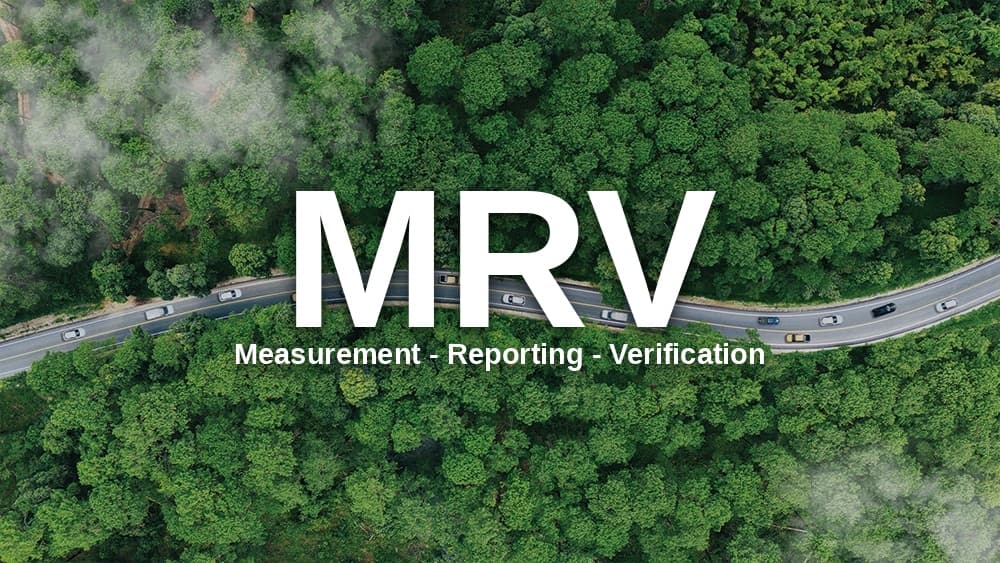
MRV stands for three core stages: Measurement, Reporting, and Verification. This is a process designed to quantify, monitor, and ensure the validity of emission reduction results.
- Measurement: Collecting actual input data such as electricity consumption, fuel, raw materials, wastewater and emission parameters, or land management activities. This activity uses direct measuring tools, IoT sensors, or satellite data.
- Reporting: Synthesizing, calculating, and presenting emission reduction results according to recognized methodologies, reporting templates, and standards.
- Verification: The process by which independent third-party auditing units inspect and evaluate the accuracy, transparency, and reliability of the data.
Thus, simply put, the MRV system addresses three major questions of the market: How much do businesses emit? How much has been cut? Is that figure proven by reliable data evidence?
Why is MRV the "data foundation" of the carbon market?
The carbon market operates on trust and accuracy. Without MRV, carbon credits are just unsubstantiated claims; with MRV, they become commercial assets. First of all, MRV helps create three irreplaceable characteristics, including:
- Comparability Helps convert all reduction activities across different sectors into a single standard unit (tCO₂e) according to a unified standard.
- Transferability Buyers are only willing to pay when they believe the credit represents 1 tCO₂e of actual emission reduction. This belief comes from MRV data evidence rather than empty promises from the seller.
- Auditability: Allows traceability and data provenance to serve inspections and independent audits.
Second, MRV helps prevent the risk of "Greenwashing". This term is used when organizations make false claims about environmental benefits to enhance their image. MRV technology prevents this risk through a transparent cross-checking mechanism. As a result, projects with high-quality MRV systems can prove their actual emission reduction levels, thereby achieving higher valuations in the market. Third, MRV supports pricing carbon credits accurately and transparently. The value of a carbon credit depends on the reliability of the emission reductions it represents. Projects possessing high-quality MRV data systems and clear verification typically achieve higher trading prices in the market. The value of a carbon credit depends on the reliability of the emission reductions it represents. Projects possessing high-quality MRV data systems and clear verification typically achieve higher trading prices in the market.
In Vietnam, the legal framework for GHG emission management and the carbon market is stipulated in Decree 06/2022/NĐ-CP and amended and supplemented by Decree 119/2025/NĐ-CP. Establishing MRV helps businesses manage emission quotas effectively, finalize transparent ESG reports, and easily work with banks, investors, and partners in the global supply chain.
Important data groups constituting the corporate MRV system
To operate an effective MRV system, businesses need to collect a diverse data chain depending on their operational sector, ranging from electricity and fuel consumption, production output, to wastewater and emission treatment parameters, and baseline data before and after implementing emission reduction projects. In Vietnam, the legal framework for this activity is increasingly institutionalized through Decree 06/2022/NĐ-CP and Decree 119/2025/NĐ-CP. Establishing a proper MRV system early on not only helps businesses meet greenhouse gas inventory obligations and transparent ESG reporting but is also a mandatory condition for verifying carbon credits and participating in the global supply chain.
The MRV system collects diverse data depending on the operating sector of the facility:
- Energy and fuel data: Electricity bills, meter readings, amounts of coal, oil, gas, biomass, boiler operation logs, generators.
- Production and raw material data: Output, amount of chemicals or raw materials used, emission intensity per unit of product (kg CO₂e/ton of product).
- Wastewater treatment data: Wastewater flow rate, COD, BOD, TSS indicators, sludge volume, and recovered methane/biogas volume according to IPCC inventory guidelines.
- Emission treatment data: Exhaust gas flow rate, dust parameters, SOx, NOx, CO, treatment equipment efficiency, and periodic/automatic monitoring results.
- Emission reduction project data: Comparing data chains before and after implementing technical solutions such as installing inverters, switching fuels, or replacing high-efficiency air blowers.
Modern technology is the driving force elevating the MRV system
Integrating modern technology solutions such as IoT sensors, satellite imagery, Blockchain, and Artificial Intelligence (AI) is playing a key role in automating the MRV process, improving accuracy, and reducing monitoring costs. Among them, satellite technology and remote sensors allow real-time monitoring of forestry projects, land-use changes, and vegetation changes on a large scale. Combined with IoT networks and on-site sensor devices, the system is capable of continuously and automatically collecting emission data such as CO₂ concentration or air quality parameters. To ensure the reliability of this data chain, Blockchain technology is applied as a decentralized storage solution, preventing data falsification or manipulation, thereby preserving full integrity for credits throughout their lifecycle. The application of Artificial Intelligence (AI) and Machine Learning helps analyze large datasets, promptly detect anomalies, and enhance forecasting capabilities for emission reduction trends. Finally, seamless connectivity with third-party verification platforms via real-time data enables independent auditors to conduct assessments quickly, transparently, and objectively.
Practical limitations and the 6-step roadmap for building an MRV system
In reality, no measurement system can achieve absolute accuracy, and MRV is no exception. Errors in the MRV process usually stem from inaccurate emission factors, incomplete activity data collection, outdated methodologies, or general scientific limitations. However, the core of data governance is not striving to completely eliminate errors, but rather transparently disclosing those margins of error along with the applied assumptions. Therefore, carbon standards always require businesses to periodically update methodologies and reassess baselines. This confirms that MRV is not a one-time certification, but a process of continuous governance and improvement.
To implement a systematic MRV system and optimize resources, businesses should follow a practical roadmap consisting of 6 specific steps:
The first step is to clearly define the system's objectives, clarifying whether data collection serves internal inventories, ESG reporting, or aims at carbon credit verification.
Next, businesses establish an emission source inventory to cover all direct and indirect sources generated within the management scope.
In the third step, reviewing existing data from invoices, records, and operational logs will help identify information gaps that need supplementation.
Then, the fourth step focuses on establishing measurement and reporting processes through assigning responsible personnel, issuing standard forms, and setting collection frequency regulations.
The fifth step proceeds to check and calibrate measuring equipment, conduct internal reviews, and finalize documentation to serve auditing and verification.
Finally, businesses need to maintain continuous improvement to promptly update the system whenever there are changes in production scale, operational technology, or new legal regulations.
The MRV system is not simply a technical file but the core data foundation shaping transparency and the operation of the entire carbon market. By creating three key characteristics—comparability, transferability, and auditability—MRV turns emission reduction data from preliminary claims into financial assets with actual trading value. In the context where greenhouse gas inventory regulations and ESG reporting are increasingly institutionalized, proactively building a proper MRV system early on is a strategic step helping businesses optimize operations, strengthen their reputation with investors and partners, and confidently seize sustainable development opportunities in the future.
References
- Hệ thống MRV là gì? Vai trò trong thị trường carbon — Công ty cổ phần Công nghệ xử lý nước và Môi trường ETM
- Hiểu về công nghệ MRV cho tín chỉ Carbon — GreenUP
- MRV LÀ NỀN MÓNG DỮ LIỆU CỦA THỊ TRƯỜNG CARBON — VNDAX