

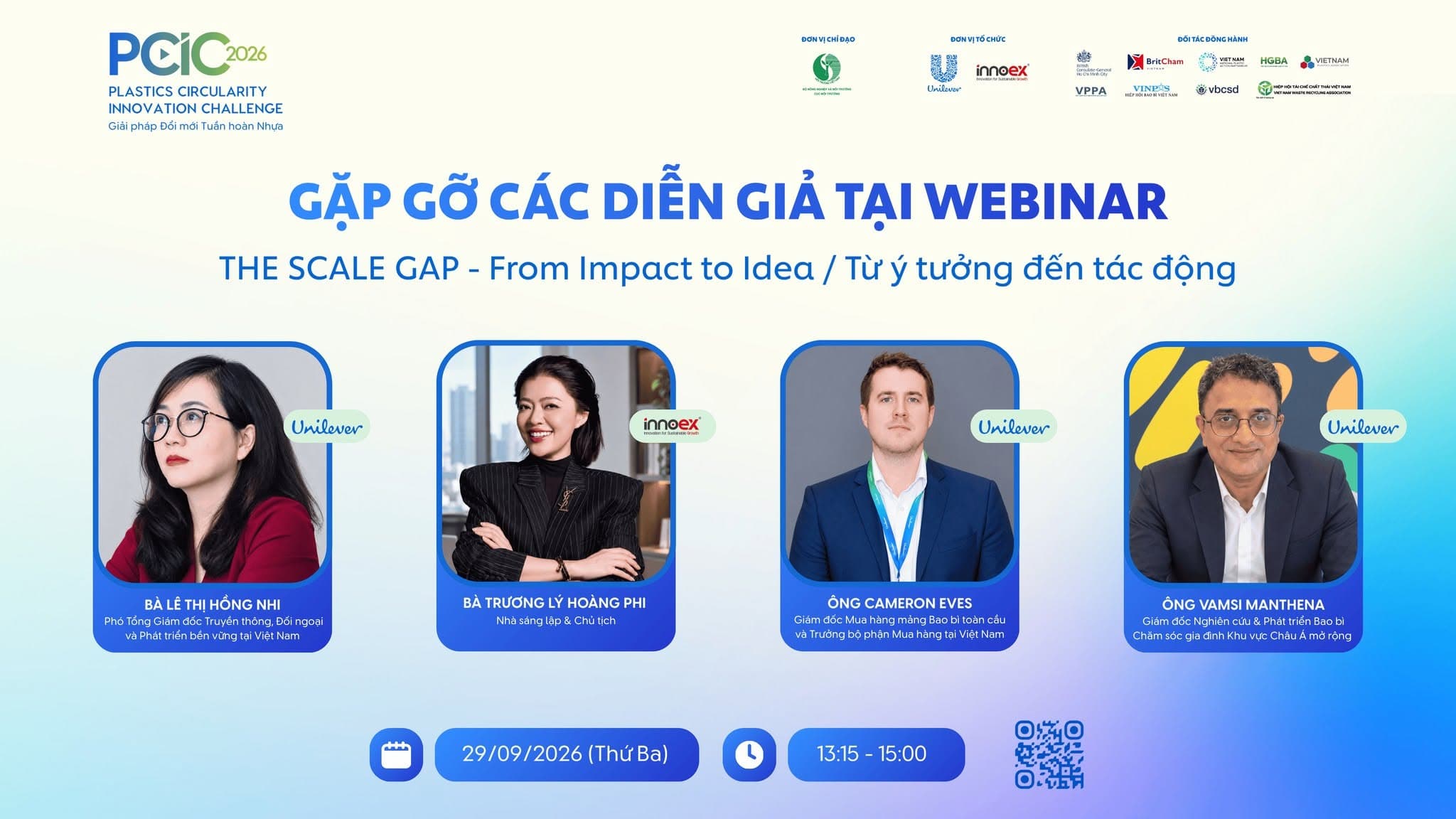
On September 29, 2026, within the framework of the Plastics Circularity Innovation Challenge 2026 (PCIC 2026), the webinar “The Scale Gap – From Idea to Impact” was held with the participation of experts from Unilever and InnoEx. The program focused on clarifying one of the biggest challenges for solution teams: how a potential idea can overcome the testing phase, meet business needs, and move towards commercialization and scale-up.
The webinar is one of the professional support activities for the PCIC 2026 ecosystem, where startups, SMEs, research groups, and solution development teams have the opportunity to directly access perspectives from large enterprises on technology, operational capabilities, commercial models, and scale-up.
When a good idea is not enough
The overarching message of the program is that a circular solution needs to be more than just novel and technically correct. To truly create an impact, the solution must also operate under real-world operational conditions, generate sufficiently clear value, align with existing systems, and possess commercialization potential.
In her opening remarks, Ms. Le Thi Hong Nhi - Vice President of Communications, External Affairs, and Sustainable Development, Unilever Vietnam emphasized that material circularity cannot stop at being just a directional sustainable development goal.
From a business perspective, the questions are always very specific: are the materials suitable, is the supply stable, what are the costs, can current production lines be utilized, and after the product is consumed, can it be collected, recycled, and returned to the material cycle?
Accordingly, the webinar outlined the gap from idea to impact through a multi-step journey:
Idea → Testing → Pilot → Commercialization → Scale-up.
A technology may work well in a laboratory or pilot phase, but when transitioning to commercial scale, issues regarding raw materials, quality, production lines, costs, logistics, standards, and markets may emerge simultaneously.
Perspective from Procurement: businesses seek long-term collaboration capabilities
In the sharing session on Procurement & Commercial, Mr. Cameron Eves - Global Packaging Procurement Director and Head of Procurement in Vietnam, Unilever argued that a solution is of interest to businesses not merely because of novelty or low cost.
Businesses comprehensively evaluate a solution's value-creation capability, including competitive advantage, contribution to sustainable development goals, ability to increase supply chain resilience, handling of supply constraints, and expansion potential.
One concept that was emphasized is partnership fit. Businesses are not just looking for a supplier for a single transaction, but are interested in the ability of both parties to jointly develop solutions, address cost issues together, and build a scale-up roadmap.
For PCIC 2026 teams, this means that proving the technology is not enough. Solution teams need to show how the technology works, what the specific sustainable benefits are, and what the path is for the solution to continue developing as demand increases.
R&D perspective: “greener” but must still run on production lines
From a technical perspective, Mr. Vamsi Manthena – Head of Research & Development for Home Care Packaging, Expanding Asia, Unilever raised the issue of balancing three factors:
Performance - Affordability - Circularity.
A solution may be more circular, but it must still ensure performance, manufacturability, and appropriate cost levels. For example, packaging from OMO in Vietnam shows that a packaging design must simultaneously meet multiple requirements: product protection, quality maintenance, transport durability, high-speed production line capability, printing and aesthetic factors, and large-scale manufacturing capability. After use, the packaging also needs a proper pathway to be collected, sorted, and recycled. From this perspective, a statement like “recyclable material” is not enough. A solution is only meaningful when it is compatible with existing collection and recycling systems.
Attendees witnessed a “system gap”
Mini-polls during the webinar showed that the system fit factor was mentioned repeatedly. About 50% of attendees believed that the biggest technical barrier is compatibility with production processes and systems. About 67% believed that the most important factor for large enterprises to be ready for collaboration is that the solution must align with business needs and operations. When asked about the condition determining scale-up capability, the most selected option continued to be the ability to integrate into existing systems and supply chains. These results indicate that a circular solution looking to go beyond the testing phase needs to be developed in relationship with the entire ecosystem, rather than just optimizing individual technologies.
Solution Clinic: bringing PCIC 2026 solutions closer to business needs
A notable highlight of the program was the Solution Clinic session, where two teams that submitted applications to PCIC 2026 had the opportunity to pitch directly in a short duration before Unilever representatives.
This activity was designed for teams to receive immediate feedback from a business perspective: what problem is being solved, does the solution fit practical needs, is the technical evidence sufficient, and what are the gaps that need further completion before thinking about commercialization or scale-up.
This approach truly reflects the spirit of PCIC 2026: not only searching for innovative ideas, but creating conditions for solutions to be challenged by the practical demands of the market.
From competition to the path of commercialization
One of the lessons emphasized at the webinar is that startups, research groups, and solution teams should not wait until the product is complete before starting to look for businesses.
Businesses, suppliers, recyclers, experts, and investors need to be brought in early to jointly shape requirements regarding technology, quality, cost, and integration capability.
This is also how PCIC 2026 aims to narrow the gap between an innovation competition and the ability to create real-world impact.
The path mentioned in the webinar can be summarized by the chain:
Competition → Pilot → Partnership → Commercialization → Scale-up.
The concluding message of the program also encapsulated this spirit: “Innovation starts with solutions. Impact starts when the whole system can afford it.” For teams participating in PCIC 2026, the webinar “The Scale Gap – From Idea to Impact” therefore not only provided additional knowledge, but also posed an important question before continuing to finalize their applications and solutions: are their ideas ready to step from innovation to implementation?