From "waste" to "resource"
In the traditional production model, raw materials enter the factory, products are created, and the remainder typically becomes waste that needs to be collected, treated, or disposed of.
Industrial symbiosis introduces a different approach: the output of one process can become the input of another.
According to the United Nations, industrial symbiosis is the cooperation between businesses, usually located close to each other geographically, to exchange material by-products, energy, or water. As a result, waste from one production process can become a raw material for another process.
For example, fly ash from coal combustion can be used as a partial substitute material in the production of building materials. Instead of just treating a waste stream, businesses can create additional value from that very material source.
UNIDO also describes industrial symbiosis in a similar direction: businesses can exchange materials, energy, and services, while sharing related infrastructure. A by-product that no longer has value for one business can be reused or upgraded to become the input of another.
Industrial symbiosis is not synonymous with "bringing trash from one factory to another".
Exchange streams can include raw materials, water, energy, waste heat, by-products, and scrap. Businesses can also share certain infrastructure or services to reduce the need for individual investments.
In Vietnam, Circular 05/2025/TT-BKHĐT guiding the development of eco-industrial parks stipulates forms of industrial symbiosis such as input and output exchanges serving production; shared infrastructure and services; as well as linkages among businesses in collecting, treating, reusing, and recycling waste, recovering energy and waste heat, and water circularity.
This shows that industrial symbiosis is not only a waste treatment solution but also directly related to how businesses manage resources throughout the entire production process.
One business reduces waste, another reduces material demand

The benefits of industrial symbiosis lie in a two-way relationship. Businesses with by-products can reduce the amount of waste to be treated and find additional economic value from this material stream. Meanwhile, businesses receiving by-products can reduce their demand for virgin raw materials. If businesses are located close to each other, the exchange can also help reduce transportation distances and related costs and emissions.
UNEP also views industrial symbiosis as a way to turn one company's waste into a valuable raw material for another, thereby enhancing resource efficiency and reducing environmental impact.
From individual businesses to eco-industrial parks
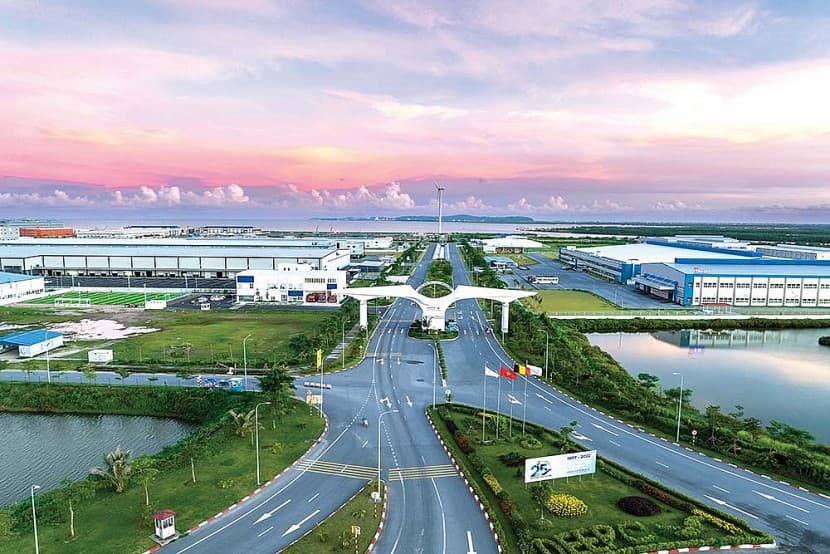
Industrial symbiosis is most effective when multiple businesses are located within the same production area.
Instead of each factory operating as a closed system, businesses can be connected into a network: company A provides by-products to company B, company B provides heat or treated water to company C, while another unit handles the collection and recycling of materials. This is also one of the foundations of an eco-industrial park.
In Vietnam, the eco-industrial park model has been integrated into the legal framework through Decree 35/2022/NĐ-CP and guided more specifically in Circular 05/2025/TT-BKHĐT. New eco-industrial park projects must project industrial symbiosis plans and monitoring mechanisms for inputs and outputs regarding raw materials, water, energy, chemicals, waste, and scrap.
Vietnam has also cooperated with UNIDO and the World Bank to develop the eco-industrial park model, in which researched solutions include wastewater reuse, using waste as inputs, heat recovery, and sharing certain services and infrastructure.
How to make "waste" become a resource?
Not all types of waste can be directly introduced into another production process. For a symbiotic link to operate, businesses need to clearly identify which material streams can be exchanged, what the quality is, what the volume is, who has the demand, and what the legal and technical conditions for use are.
Therefore, the first step is usually not trying to "recycle everything", but mapping the material, water, energy, and waste streams within the production area. When knowing which business has a surplus resource and which business needs that very resource, new symbiotic "connection points" can be formed.
Industrial symbiosis changes the perspective on waste: a material stream discarded in one place does not necessarily lose its value elsewhere. If organized properly, this model can simultaneously reduce waste, save materials, optimize costs, and reduce pressure on natural resources.
That is also the core mindset of the circular economy: instead of ending the resource lifecycle after a single use, ways are found to bring material streams back into the economy to continue creating value.